Once I understood how the tax works, I wanted to know who was actually getting my money. So I pulled the County's own numbers.
First, the word. A levy is just a tax that one government body — the state, the county, your city, a school or fire or parks district — charges to fund its budget. Each is quoted as a levy rate: dollars per $1,000 of assessed value. Your bill is every levy that applies to your address, stacked together, and the exact bundle is identified by a levy code tied to your location. Here's a real one:
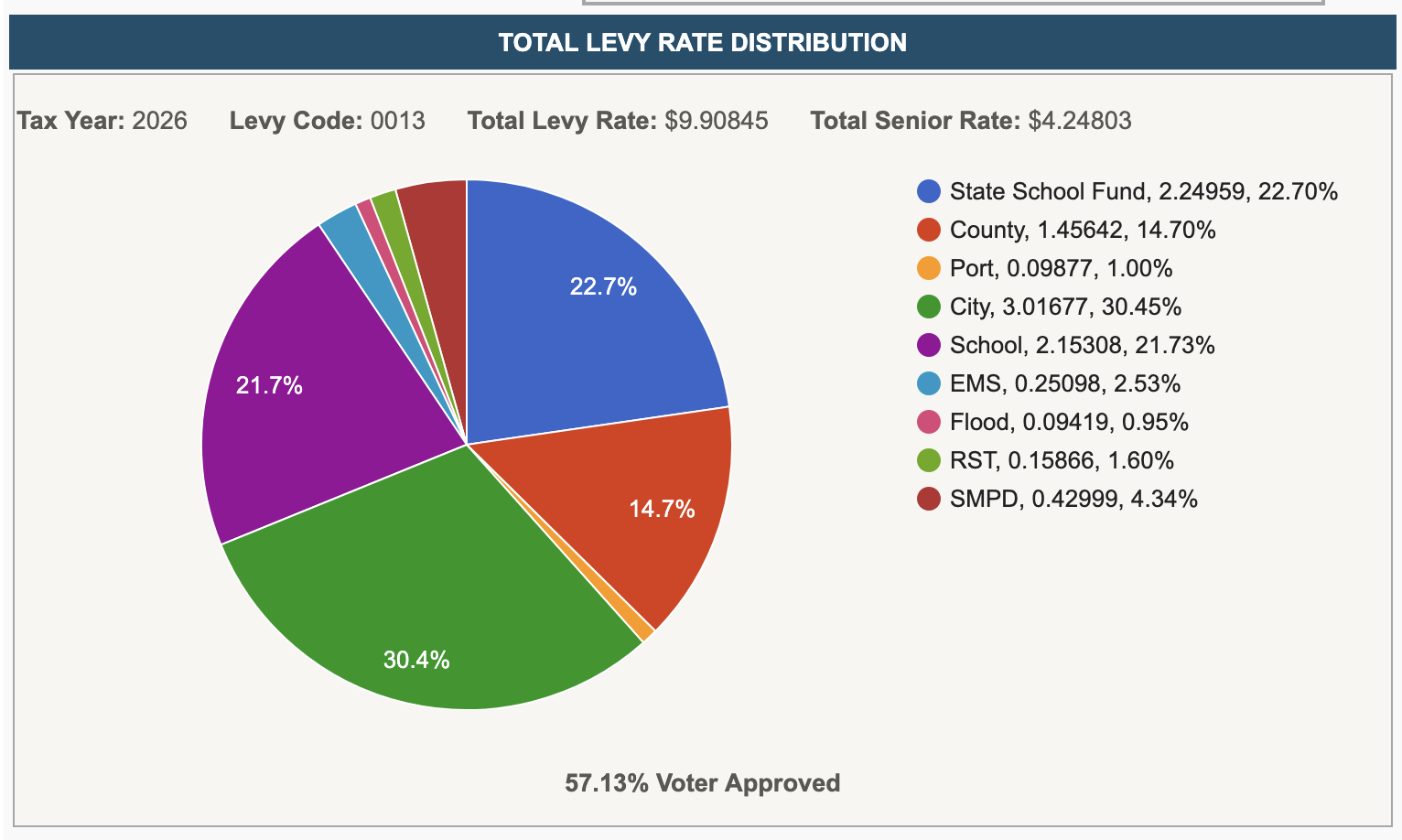
What each slice means, biggest first:
- City — 30.4%. Your city government (this code is Seattle): police, fire, parks, streets, general operations. The single biggest slice here.
- State School Fund — 22.7%. Washington's statewide property tax for K–12 public schools.
- School — 21.7%. Your local school district's own voter-approved levies and construction bonds. Add the two school lines and schools are ~44% of the bill — nearly half.
- County — 14.7%. King County services: sheriff, courts, roads, public health, regional programs.
- SMPD — 4.3%. The Seattle Metropolitan Park District — a voter-created district funding parks and recreation.
- EMS — 2.5%. Emergency Medical Services — the Medic One paramedic system.
- RST — 1.6%. Regional transit (Sound Transit). Smaller than most people assume — the bulk of transit money is sales tax, not your property bill.
- Port — 1.0%. Port of Seattle: Sea-Tac airport and the seaport.
- Flood — 0.9%. King County Flood Control District: levees and drainage.
Some of it I'm genuinely happy to fund. Some of it I have opinions about. But here's what reframed the whole problem for me: "I don't like where it goes" is not an argument the county will hear. It's not a fight you can win — and your own levy code splits a little differently from this one anyway.
The fight you can win is the number this whole stack gets multiplied against: your assessed value. And that rests on a distinction most people never think about — assessed value vs. market value. That's where the opening is.